

Collection of Letters from a Virginia Family Discussing Education, Subscriptions to “make a school in Newcastle”, and Civil War Rumors of “30000 Yankees [...] along the Coast of N. Carolina”; 1843–1893
- Eight letters, two pages of genealogical notes, and one empty envelope. One letter missing top half of paper; generally worn wit
- Virginia, Missouri, and Mississippi , 1893
Virginia, Missouri, and Mississippi, 1893. Eight letters, two pages of genealogical notes, and one empty envelope. One letter missing top half of paper; generally worn with musty scent. Overall very good.. A small collection of letters between members of the Minor family of Virginia, particularly John Francis Minor (b. 1809), his daughter Eliza Frances (b. 1833), and his son Alexander Aurelius (b. 1835); with two pages of genealogical notes on the Noell and Whiteley families. Early letters mainly concern schooling. John Minor writes to Eliza:
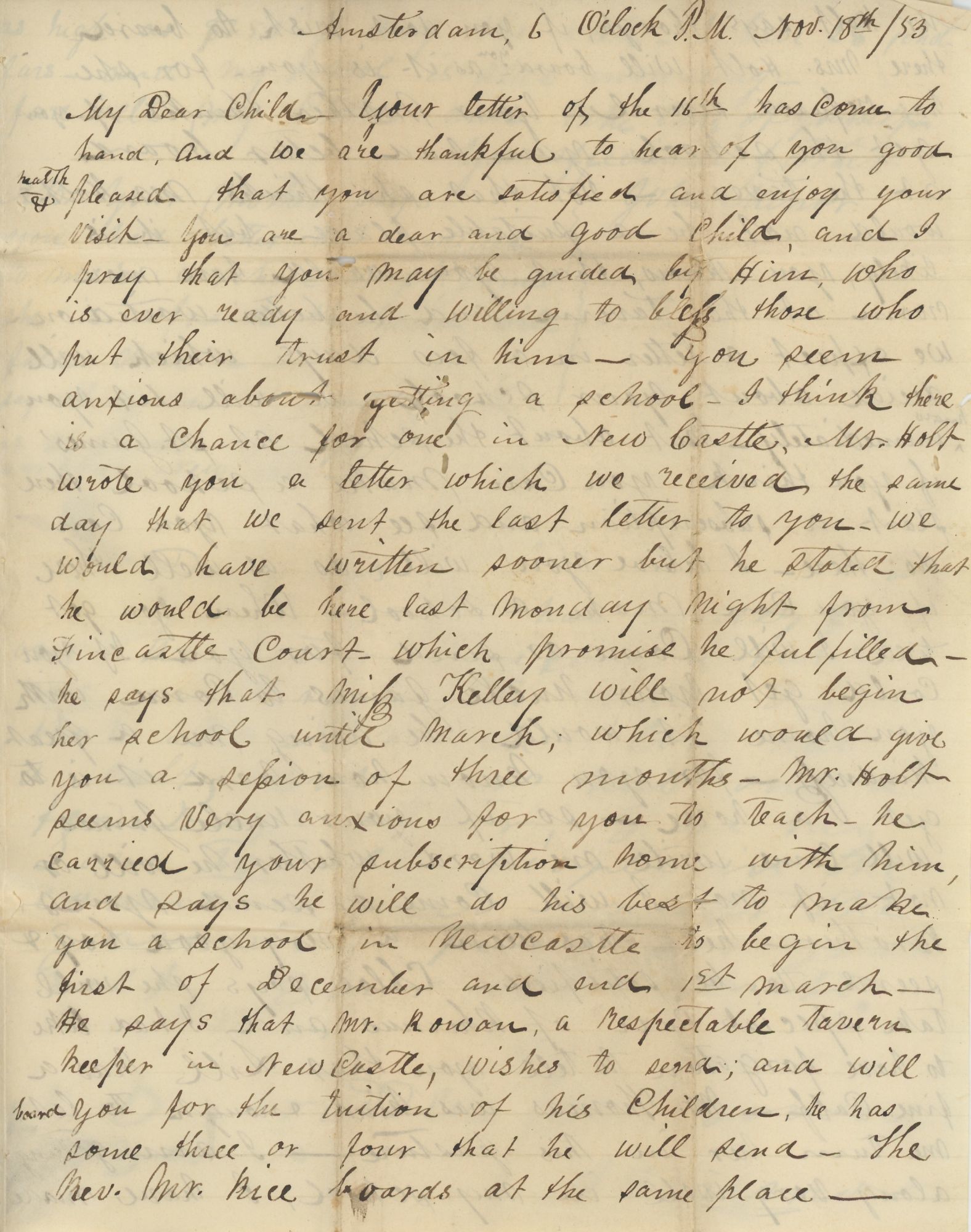
“You seem anxious about getting a school. I think there is a chance for one in New Castle, Mr. Holt wrote you a letter which we received the same day that we sent the last letter to you. We would have written sooner but he stated that he would be here last Monday night from Fincastle Court – which promise he fulfilled – he says that Miss Kelley will not begin her school until March; which would give you a session of three months. Mr. Holt seems very anxious for you to teach – he carried your subscription home with him, and he says he will do his best to make you a school in Newcastle to begin the first of December and end 1st March — He says that Mr. Rowan, a respectable tavern keeper in New Castle, wishes to send; and will board you for the tuition of his children.” (November 18, 1853)
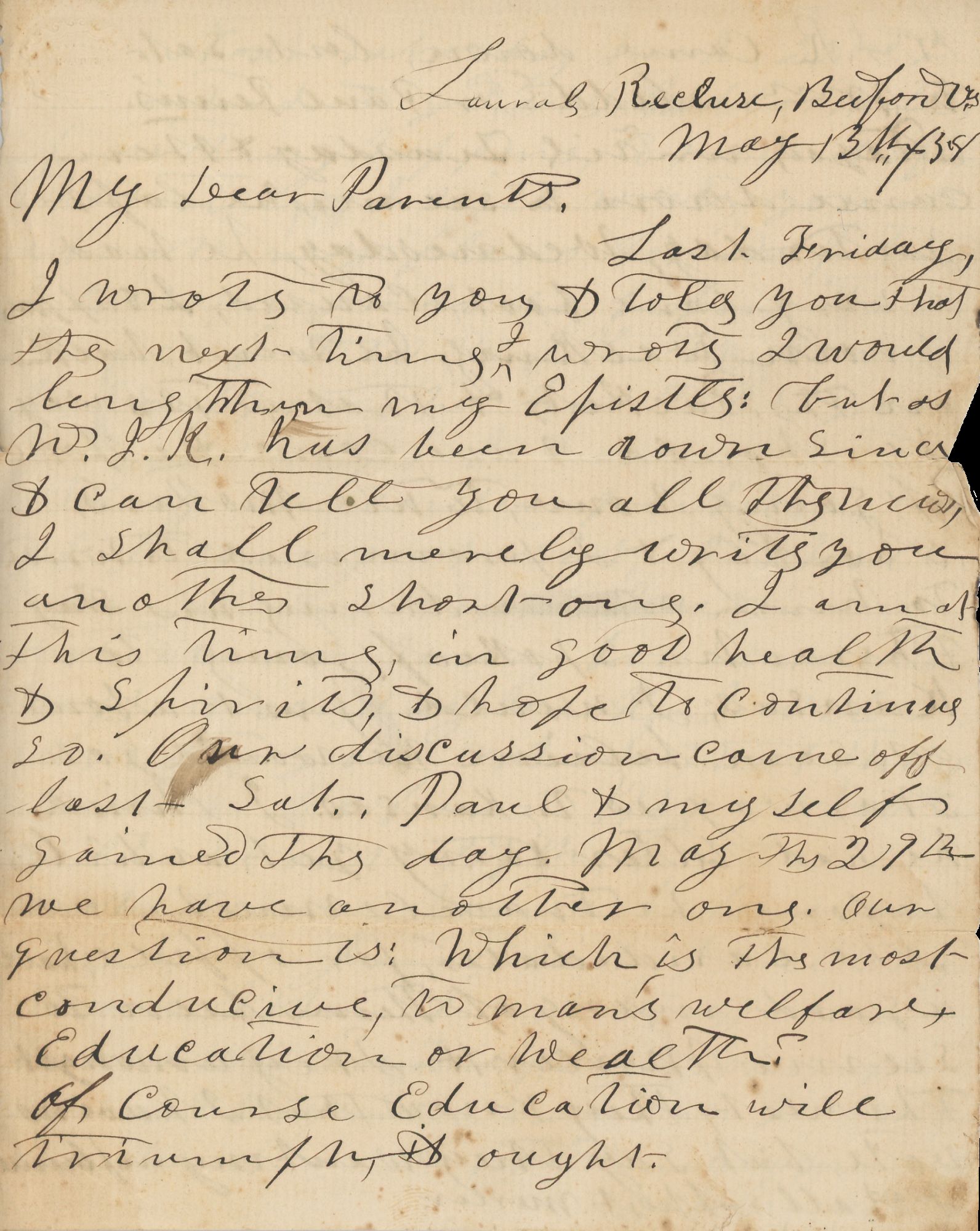
Alexander Minor attended a school in Bedford County, Virginia—possibly the New London Academy, though the headings of his letters from school give the location as “Laural Recluse, Bedford, VA”, which turns up no results. He writes:
“I arrived safe here, on the same day, that I left home. My school has increased somewhat; I have now 21 scholars, and a prospect for more. Our Debating Soc. is flourishing & promises to be an exception to anything, of the kind, I ever saw. Our question for next Friday, is, “Would it be profitable, to the south, to Dissolve the Union? Mr. D. Shrader & myself are the compts.” (April 13, 1858)
Minor “gained the day” on the debate, and was preparing for the next: “Which is the most conducive, to man’s welfare, education or wealth? Of course Education will triumph; it ought” (May 13, 1858).
He would go on to fight for the Confederacy in the Civil War. During this time, his father writes to him (note that the top half of the paper is missing):
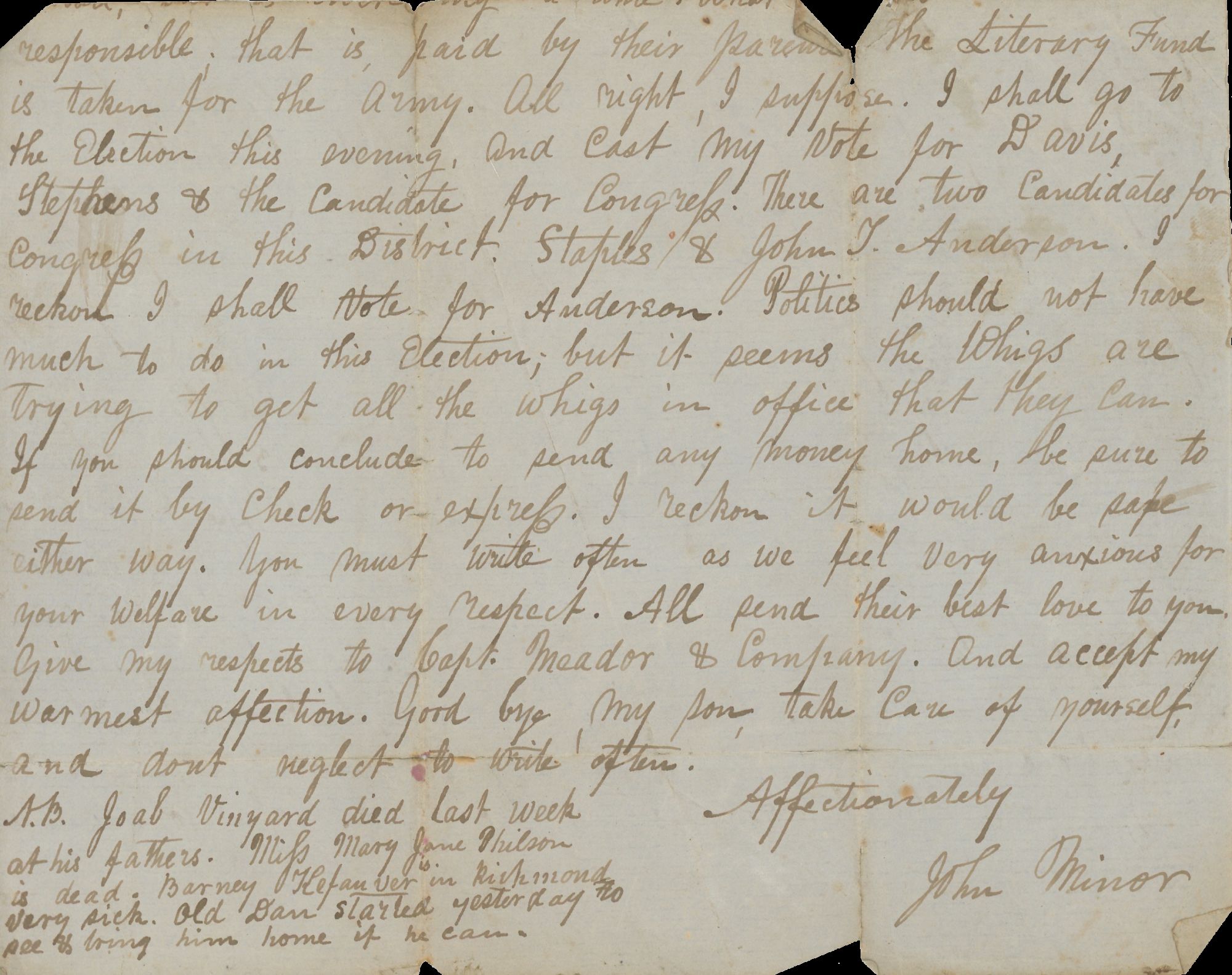
“You are enlisted in a good & great cause; the defence of your Country & your family. [...] We have, as usual, [heard] a good many rumors about battles in different places but not much reliable. It is rumoured that 30000 Yankees have gone along the Coast of N. Carolina. I expect we shall have hot work in the south if that be so. Some of the Roanoke Greys have returned home sick. Wm Watts came home last week, but was not very sick. Robert Vineyard also came home last week. He is not home, but riding about; and looks very well, but is very hoarse & has been so for a good while. He has a discharge. [...] I shall go to the Election this evening, and cast my vote for Davis, Stephens & the Candidate for Congress [...] I reckon I shall vote for Anderson. Politics should not have much to do in this Election; but it seems the Whigs are trying to get all the Whigs in office they can.” (N.d., likely 1861)
William Watts is possibly the Virginian Colonel (1817–1877); educated at University of Virginia, he was Roanoke County’s Commonwealth Attorney and a member of the 1850-51 State Constitutional Convention.
Of interest to historians of life in the antebellum South.
“You seem anxious about getting a school. I think there is a chance for one in New Castle, Mr. Holt wrote you a letter which we received the same day that we sent the last letter to you. We would have written sooner but he stated that he would be here last Monday night from Fincastle Court – which promise he fulfilled – he says that Miss Kelley will not begin her school until March; which would give you a session of three months. Mr. Holt seems very anxious for you to teach – he carried your subscription home with him, and he says he will do his best to make you a school in Newcastle to begin the first of December and end 1st March — He says that Mr. Rowan, a respectable tavern keeper in New Castle, wishes to send; and will board you for the tuition of his children.” (November 18, 1853)
Alexander Minor attended a school in Bedford County, Virginia—possibly the New London Academy, though the headings of his letters from school give the location as “Laural Recluse, Bedford, VA”, which turns up no results. He writes:
“I arrived safe here, on the same day, that I left home. My school has increased somewhat; I have now 21 scholars, and a prospect for more. Our Debating Soc. is flourishing & promises to be an exception to anything, of the kind, I ever saw. Our question for next Friday, is, “Would it be profitable, to the south, to Dissolve the Union? Mr. D. Shrader & myself are the compts.” (April 13, 1858)
Minor “gained the day” on the debate, and was preparing for the next: “Which is the most conducive, to man’s welfare, education or wealth? Of course Education will triumph; it ought” (May 13, 1858).
He would go on to fight for the Confederacy in the Civil War. During this time, his father writes to him (note that the top half of the paper is missing):
“You are enlisted in a good & great cause; the defence of your Country & your family. [...] We have, as usual, [heard] a good many rumors about battles in different places but not much reliable. It is rumoured that 30000 Yankees have gone along the Coast of N. Carolina. I expect we shall have hot work in the south if that be so. Some of the Roanoke Greys have returned home sick. Wm Watts came home last week, but was not very sick. Robert Vineyard also came home last week. He is not home, but riding about; and looks very well, but is very hoarse & has been so for a good while. He has a discharge. [...] I shall go to the Election this evening, and cast my vote for Davis, Stephens & the Candidate for Congress [...] I reckon I shall vote for Anderson. Politics should not have much to do in this Election; but it seems the Whigs are trying to get all the Whigs in office they can.” (N.d., likely 1861)
William Watts is possibly the Virginian Colonel (1817–1877); educated at University of Virginia, he was Roanoke County’s Commonwealth Attorney and a member of the 1850-51 State Constitutional Convention.
Of interest to historians of life in the antebellum South.