

Calendarium Romanum magnum
- Oppenheim: PerJacobum Köbel, 1518
Oppenheim: PerJacobum Köbel, 1518. Full Description:
STOEFFLER, Johann. Calendarium Romanum magnum, Cæsaree maiestati dicatum...[Oppenheim: Per Jacobum Köbel, 1518].
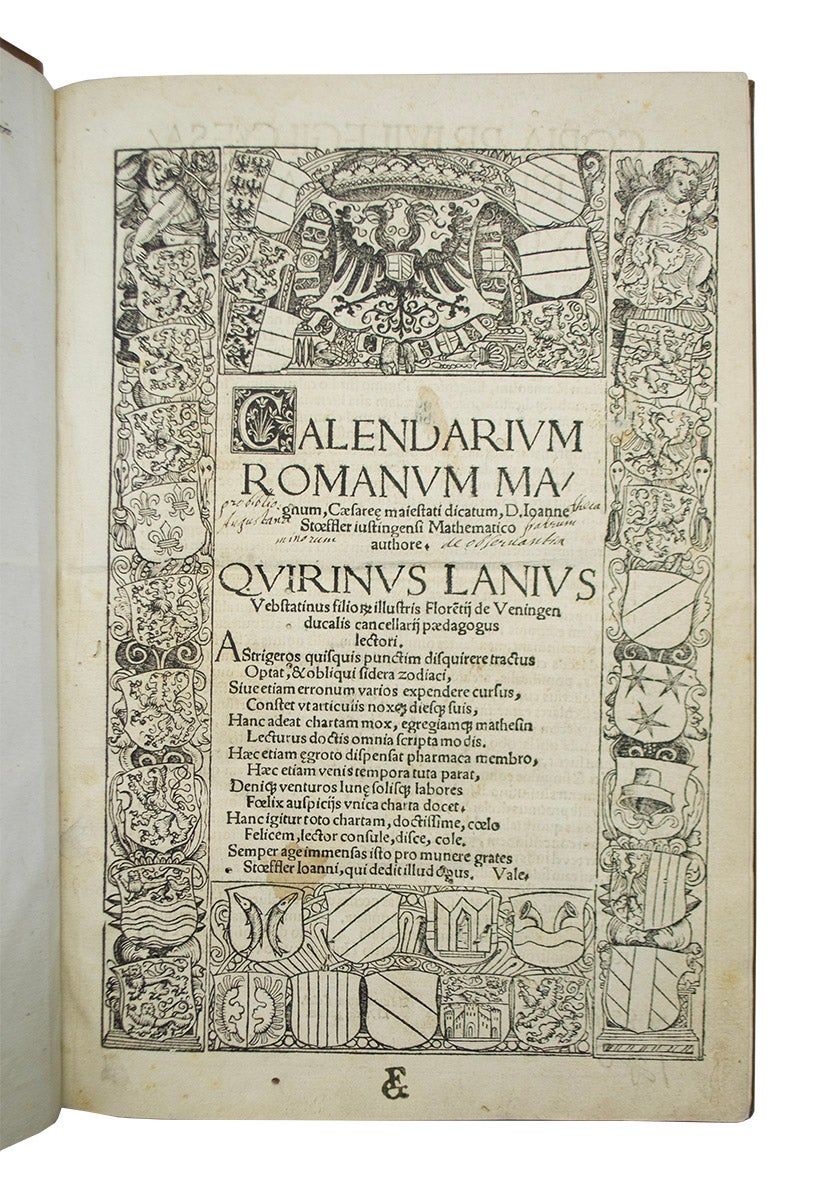
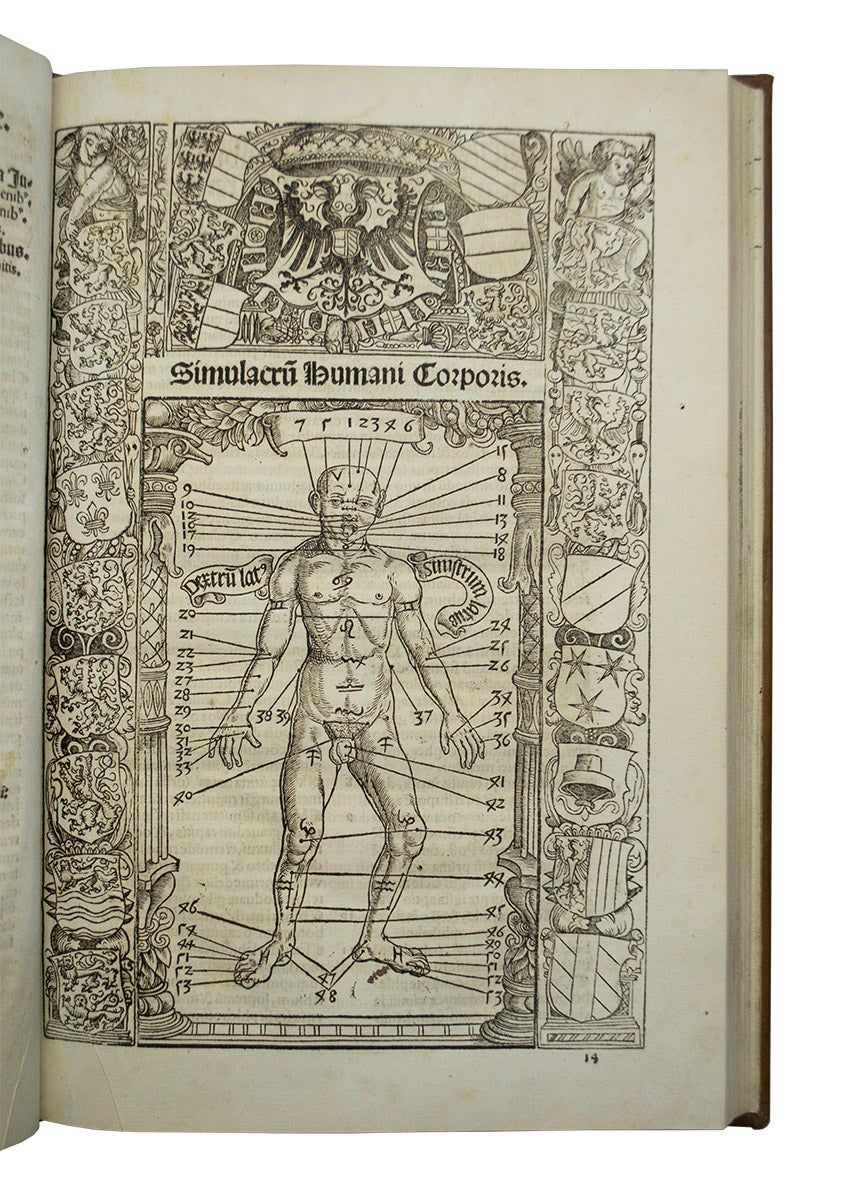
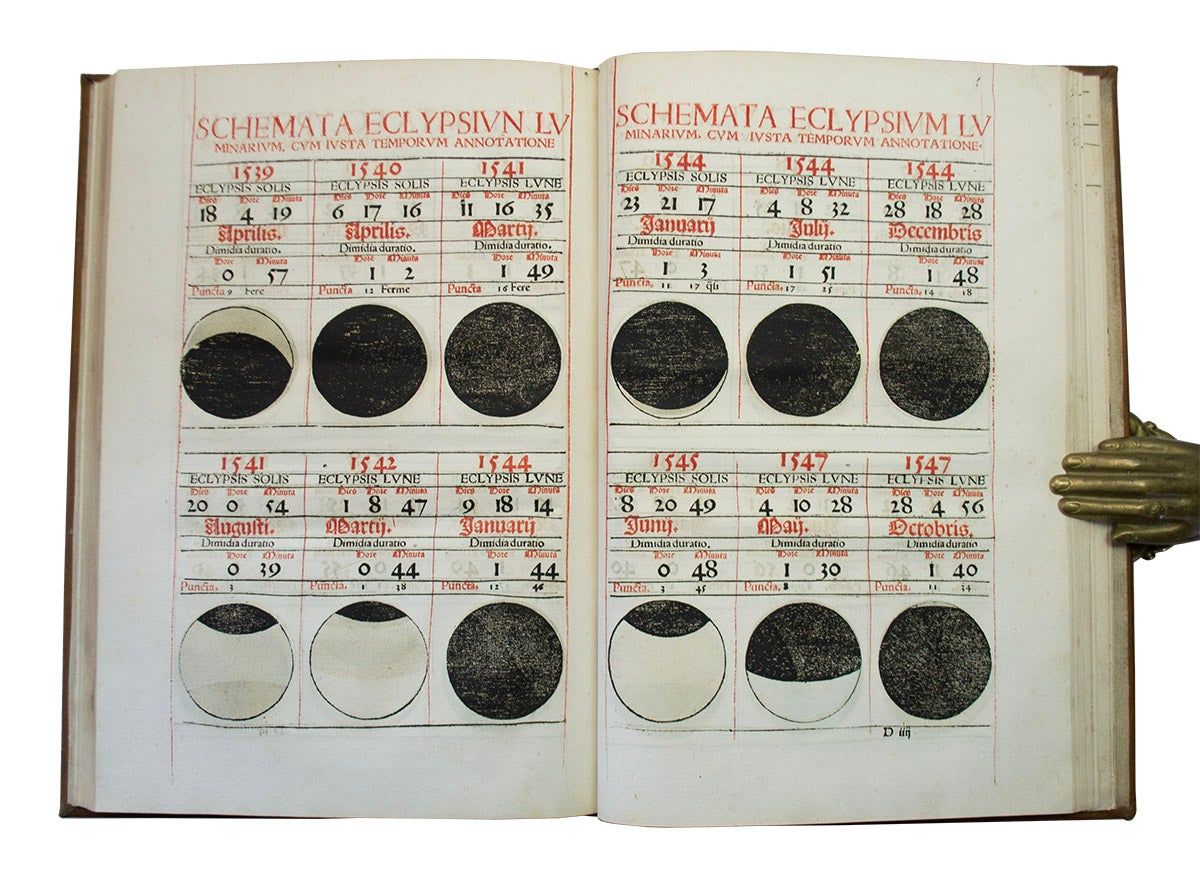
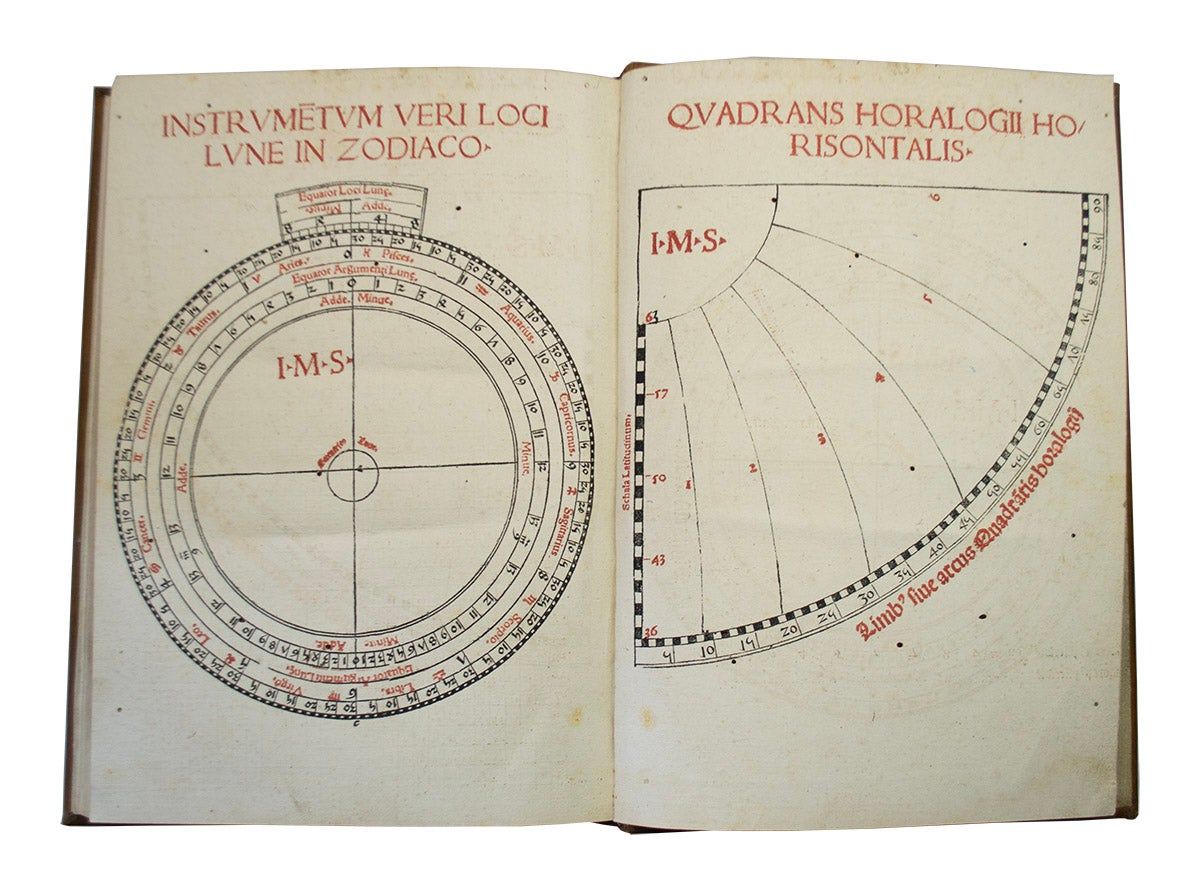
First edition. Folio. Complete. [14], 74, [50] leaves. Including the two leaves of errata after sig **. Title within woodcut border of coats of arms of the chief states of Germany, the Netherlands, and Switzerland (repeated on full-page Anatomical Man woodcut on leaf 14), woodcut architectural border on second leaf (*ii). Twenty-four small woodcut views of cities (including repeats) in the Abacus, twelve woodcuts of the monthly occupations and twelve woodcut medallions representing the signs of the zodiac in the Calendar, sixty-three woodcut diagrams of solar and lunar eclipses, four full-page woodcut diagrams of astronomical instruments in red and black at the end. White-on-black (one twelve-line and numerous four- and seven-line) foliate woodcut initials. Calendar and tables printed in red and black.
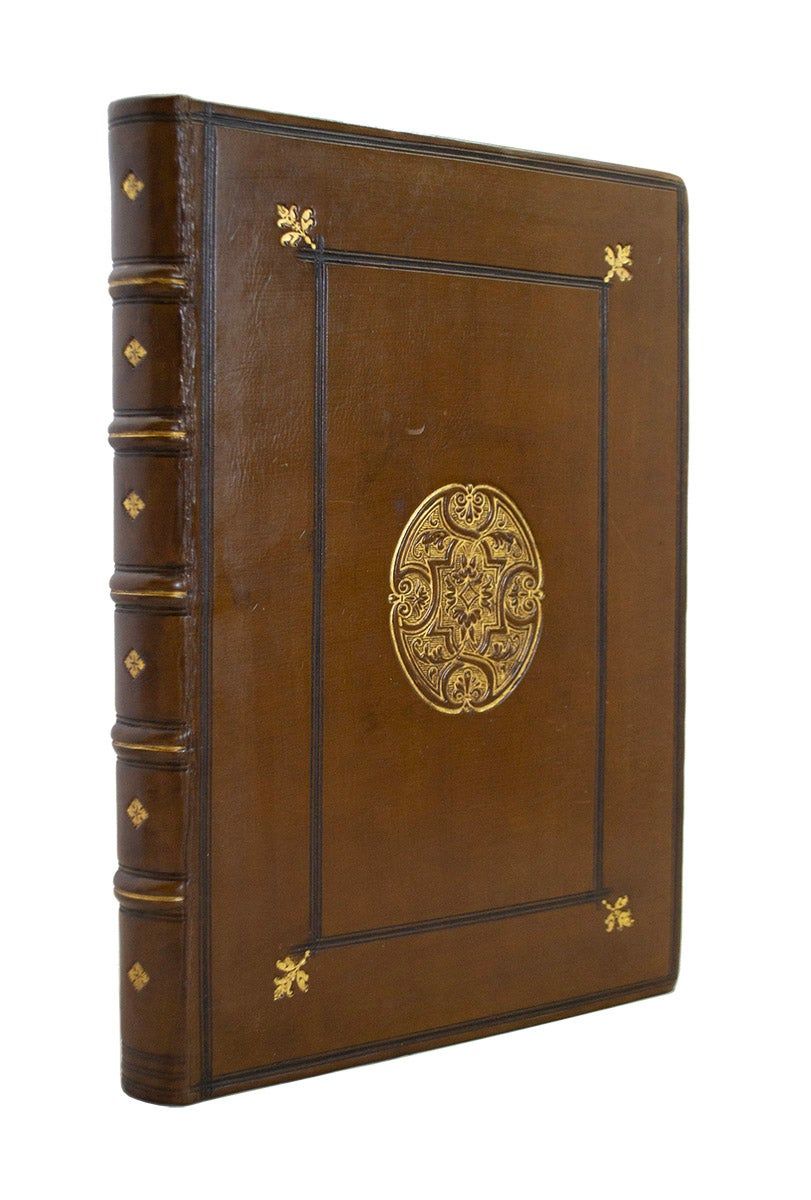
Bound to style in full modern calf. Boards ruled in blind. Gilt central device and gilt corners. Spine stamped in gilt. Board edges ruled in gilt. Previous owner's old ink notes to front fly leaf. Some minor worm holes throughout, only ever affecting a few letters. Some scattered light marginal dampstaining. The twelve woodcut medallions representing the signs of the zodiac in the calendar are trimmed close at fore-edge, just touching the woodcut. The final full page woodcut diagram is trimmed close at fore-edge, just touching diagram. Some invisible repairs to gutter of final leaves. Overall a very good and clean copy.
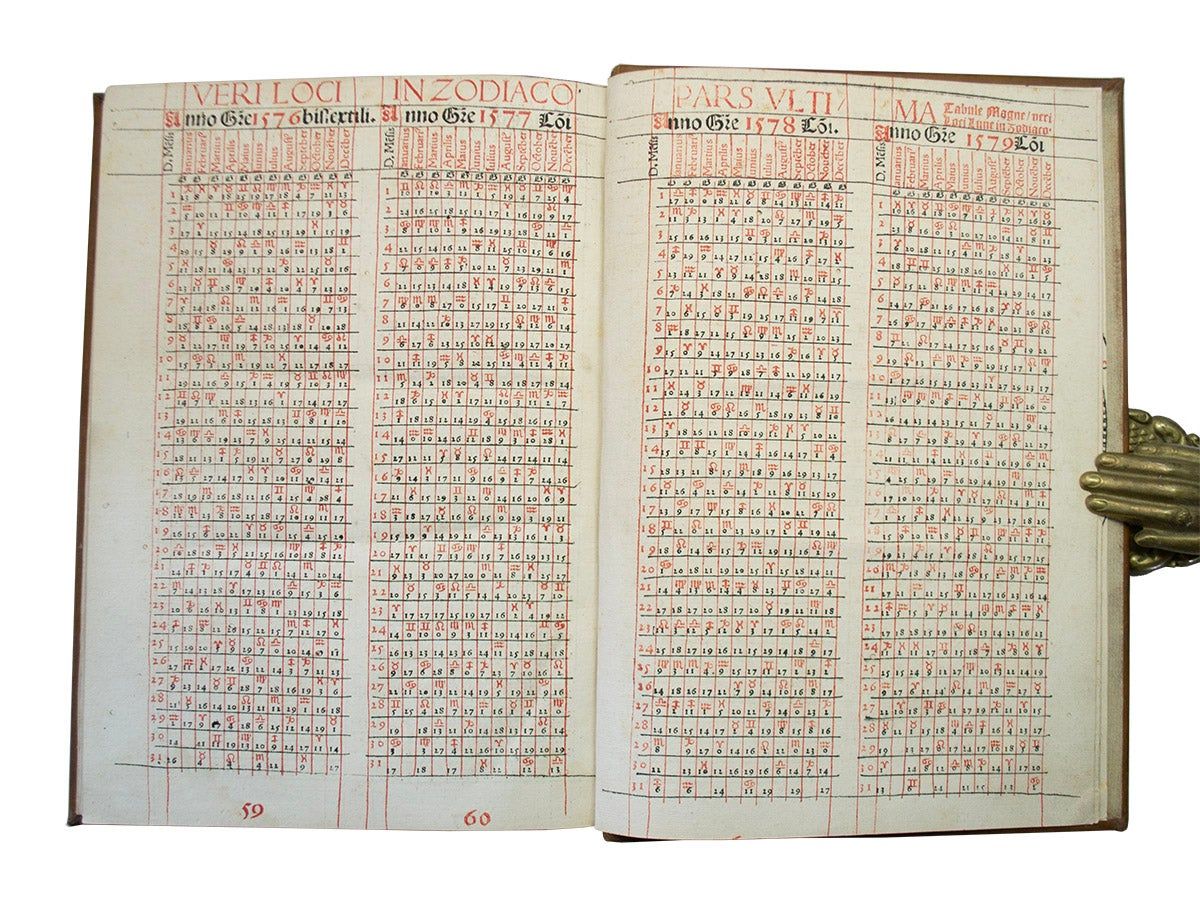
This compendium of astronomical, cosmographical, medical, and historical writings is probably the best known specimen of Koebel’s press. At the Lateran Council, Stoeffler was commissioned to revise the calendar, and this handsome illustrated work was the result of his labors. The numbered leaves consist of forty-one propositions devoted to the zodiac, eclipses, the calculation of Easter, etc. There is an “Abacus Regionum per totam ferme Europam,” giving the positions of various places, beginning with England, Ireland, and Scotland. This occupies twenty-four columns at the bottom of each of which is a small woodcut of a town or a battle, some of the towns, such as Venice, being recognizable. After this comes the Calendar, beautifully printed in red and black, with woodcuts showing the occupations appropriate to each month. Following this is a section on the eclipses of the sun and the moon from 1518 to 1573 and astronomical talbes for the years 1518 to 1579 inclusive. There is an extensive section on phlebotomy and purgatives, giving the proper places for these operations at various seasons.
Stoeffler (1452-1531), professor of astronomy at Tübingen University, was one of the first to show how the Julian calendar could be brought into harmony with astronomical events. He did, however, make one absurd prediction—that the Great Flood would occur again in 1524. There was great consternation because of this, and the people of Toulouse even went so far as to build an ark! Stoeffler, however, seems to have survived the failure of his prediction, for he published a new ephemeris in the year of his death.
Jakob Koebel (1460-1533) operated the first printing press at Oppenheim, producing his first publication in 1499. “This work is prized partly on account of the excellence of the tables calculated by Stoeffler...one of the most eminent astronomers of the age, and also for the small woodcuts at the foot of each page of the Calendar, representing the occupations of the husbandman throughout the year” (G.R. Redgrave, “Some Early Book-Illustrations of the Oppenheim Press,” Transactions of the Bibliographical Society III, pp. 71-80).
First edition of a work from the first press of Oppenheim, which operated from 1503 to 1532. In addition to extensive astronomical information, this work contains sections on blood-letting, ancient and modern observances of Easter and reform of the calendar. Stoeffler was Professor of Astronomy at Tübingen University. Koebel published a German translation of the calendar in 1522.
Adams S1884. Fairfax Murray, German, 403. Houzeau & Lancaster 13730. Stillwell, Science, 112. Wellcome 6102. Zinner 1101.
HBS 69421.
$12,500.
STOEFFLER, Johann. Calendarium Romanum magnum, Cæsaree maiestati dicatum...[Oppenheim: Per Jacobum Köbel, 1518].
First edition. Folio. Complete. [14], 74, [50] leaves. Including the two leaves of errata after sig **. Title within woodcut border of coats of arms of the chief states of Germany, the Netherlands, and Switzerland (repeated on full-page Anatomical Man woodcut on leaf 14), woodcut architectural border on second leaf (*ii). Twenty-four small woodcut views of cities (including repeats) in the Abacus, twelve woodcuts of the monthly occupations and twelve woodcut medallions representing the signs of the zodiac in the Calendar, sixty-three woodcut diagrams of solar and lunar eclipses, four full-page woodcut diagrams of astronomical instruments in red and black at the end. White-on-black (one twelve-line and numerous four- and seven-line) foliate woodcut initials. Calendar and tables printed in red and black.
Bound to style in full modern calf. Boards ruled in blind. Gilt central device and gilt corners. Spine stamped in gilt. Board edges ruled in gilt. Previous owner's old ink notes to front fly leaf. Some minor worm holes throughout, only ever affecting a few letters. Some scattered light marginal dampstaining. The twelve woodcut medallions representing the signs of the zodiac in the calendar are trimmed close at fore-edge, just touching the woodcut. The final full page woodcut diagram is trimmed close at fore-edge, just touching diagram. Some invisible repairs to gutter of final leaves. Overall a very good and clean copy.
This compendium of astronomical, cosmographical, medical, and historical writings is probably the best known specimen of Koebel’s press. At the Lateran Council, Stoeffler was commissioned to revise the calendar, and this handsome illustrated work was the result of his labors. The numbered leaves consist of forty-one propositions devoted to the zodiac, eclipses, the calculation of Easter, etc. There is an “Abacus Regionum per totam ferme Europam,” giving the positions of various places, beginning with England, Ireland, and Scotland. This occupies twenty-four columns at the bottom of each of which is a small woodcut of a town or a battle, some of the towns, such as Venice, being recognizable. After this comes the Calendar, beautifully printed in red and black, with woodcuts showing the occupations appropriate to each month. Following this is a section on the eclipses of the sun and the moon from 1518 to 1573 and astronomical talbes for the years 1518 to 1579 inclusive. There is an extensive section on phlebotomy and purgatives, giving the proper places for these operations at various seasons.
Stoeffler (1452-1531), professor of astronomy at Tübingen University, was one of the first to show how the Julian calendar could be brought into harmony with astronomical events. He did, however, make one absurd prediction—that the Great Flood would occur again in 1524. There was great consternation because of this, and the people of Toulouse even went so far as to build an ark! Stoeffler, however, seems to have survived the failure of his prediction, for he published a new ephemeris in the year of his death.
Jakob Koebel (1460-1533) operated the first printing press at Oppenheim, producing his first publication in 1499. “This work is prized partly on account of the excellence of the tables calculated by Stoeffler...one of the most eminent astronomers of the age, and also for the small woodcuts at the foot of each page of the Calendar, representing the occupations of the husbandman throughout the year” (G.R. Redgrave, “Some Early Book-Illustrations of the Oppenheim Press,” Transactions of the Bibliographical Society III, pp. 71-80).
First edition of a work from the first press of Oppenheim, which operated from 1503 to 1532. In addition to extensive astronomical information, this work contains sections on blood-letting, ancient and modern observances of Easter and reform of the calendar. Stoeffler was Professor of Astronomy at Tübingen University. Koebel published a German translation of the calendar in 1522.
Adams S1884. Fairfax Murray, German, 403. Houzeau & Lancaster 13730. Stillwell, Science, 112. Wellcome 6102. Zinner 1101.
HBS 69421.
$12,500.