

Portrait etching. 1711
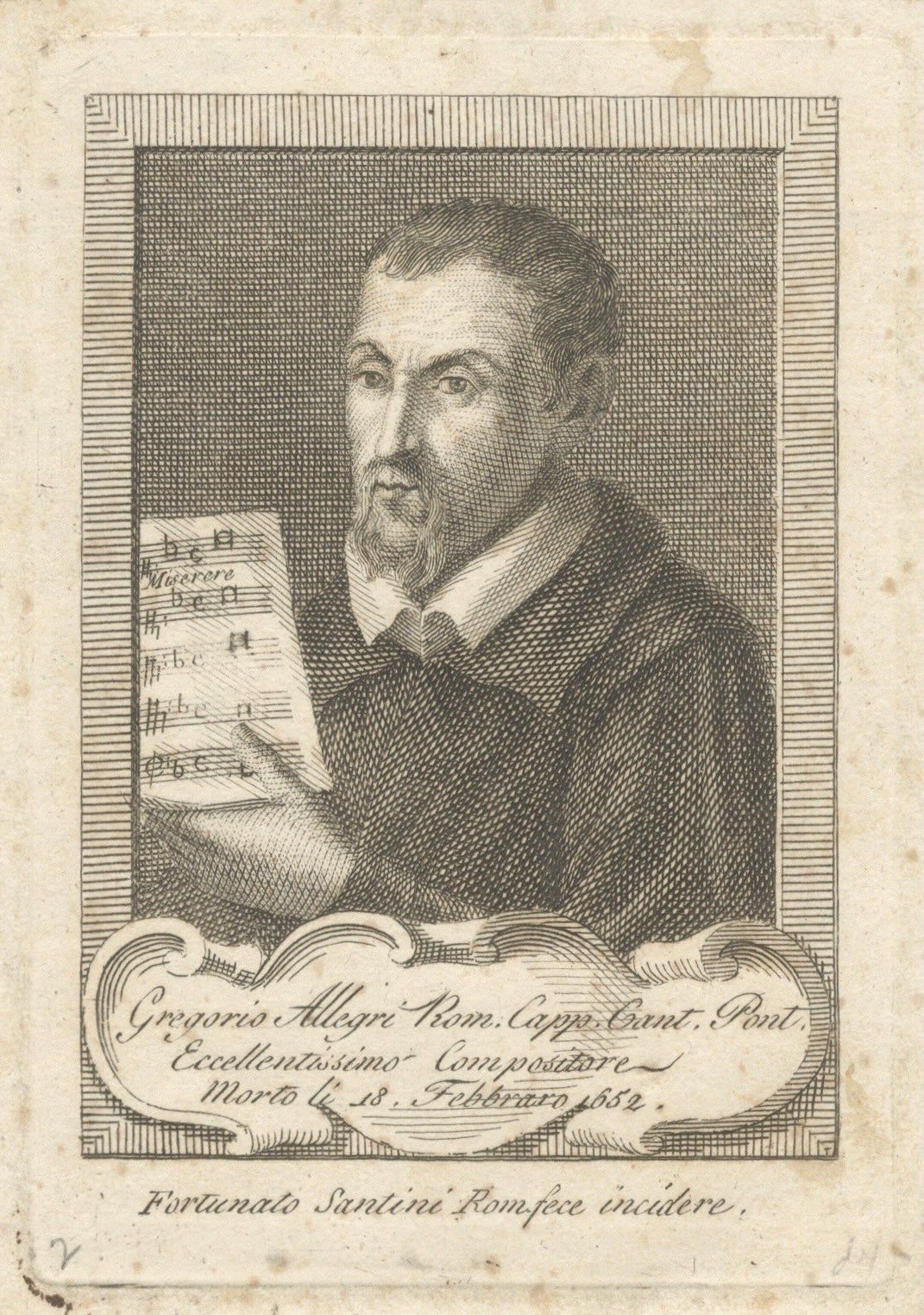
Image size to platemark 122 x 83; sheet size 131 x 93 mm. Long bust-length image of the composer holding a sheet of music of his noted "Miserere" with his left hand within a rectangular border with three lines of biographical text to cartouche below and "Fortunato Santini Rom. fece incidere" under image.
Very slightly worn, foxed, and stained; verso with dates in ink to lower margin and minor remnant of mounting tape to upper margin. British Museum number 1944,1014.455. Kinsky p. 162, no. 5.
Allegri was an Italian composer and singer whose "fame stems largely from his Miserere, a setting of Psalm li, which, up until 1870, was traditionally sung by the papal choir during the Tenebrae Offices of Holy Week. ... [His] best music is in the a cappella style, much of it for two choirs: it was copied and recopied into Cappella Sistina manuscripts for at least a century. A fine example is the six-part Missa ‘Vidi turbam magnam’; based on his own motet it shows that the stile antico, far from being insipid, could be the vehicle for superbly controlled sonority and counterpoint, using syncopation to lead to a climax and with a bass line entirely harmonic in function." Jerome Roche, revised by Noel O’Regan in Grove Music Online.
Very slightly worn, foxed, and stained; verso with dates in ink to lower margin and minor remnant of mounting tape to upper margin. British Museum number 1944,1014.455. Kinsky p. 162, no. 5.
Allegri was an Italian composer and singer whose "fame stems largely from his Miserere, a setting of Psalm li, which, up until 1870, was traditionally sung by the papal choir during the Tenebrae Offices of Holy Week. ... [His] best music is in the a cappella style, much of it for two choirs: it was copied and recopied into Cappella Sistina manuscripts for at least a century. A fine example is the six-part Missa ‘Vidi turbam magnam’; based on his own motet it shows that the stile antico, far from being insipid, could be the vehicle for superbly controlled sonority and counterpoint, using syncopation to lead to a climax and with a bass line entirely harmonic in function." Jerome Roche, revised by Noel O’Regan in Grove Music Online.