

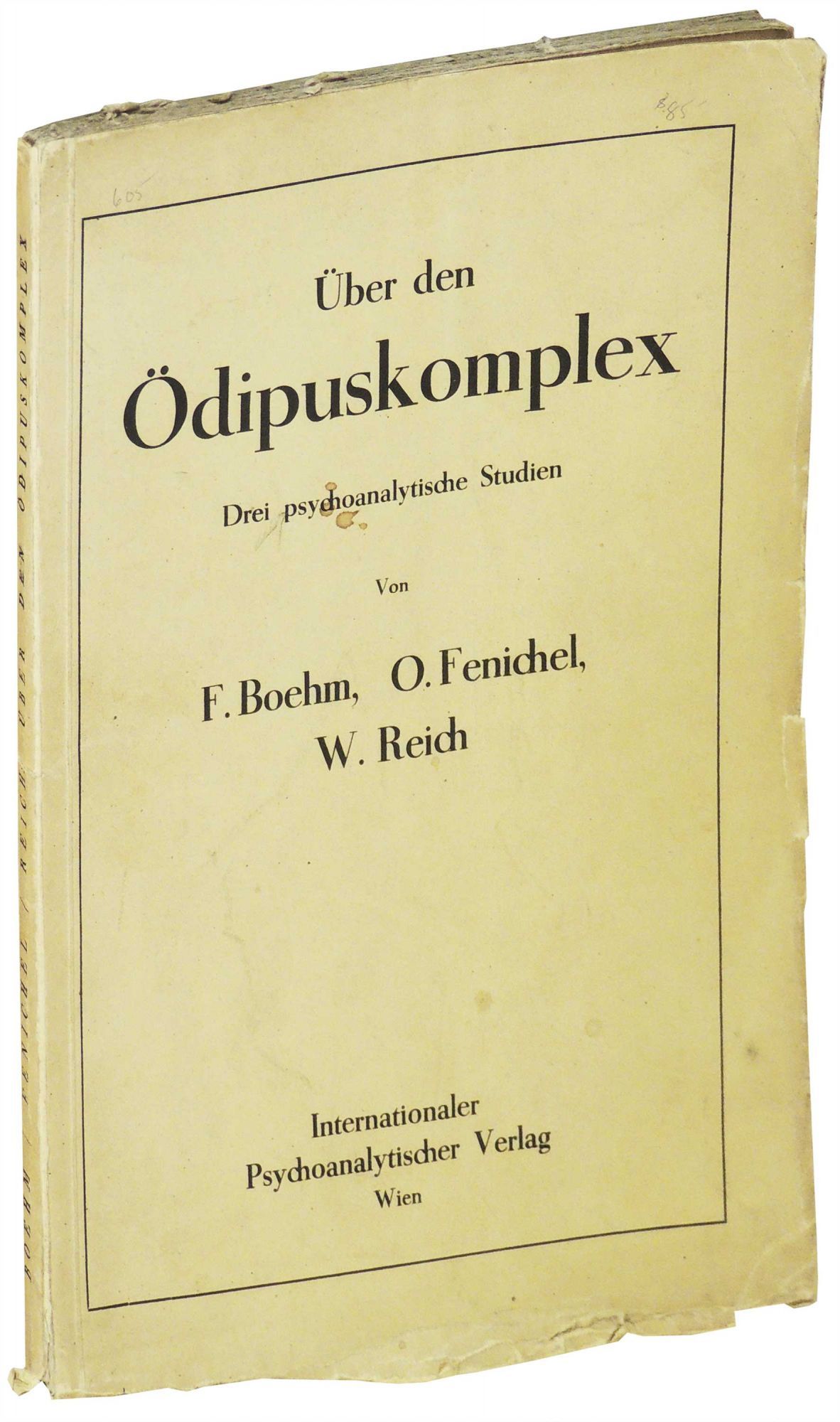
Über der Ödipuskomplex. Drei psychoanalytische Studien
- Paperback
- Wien: Internationaler Psychoanalytischer Verlag, 1931
Wien: Internationaler Psychoanalytischer Verlag, 1931. Paperback. Very Good. Paperback. First edition. "On the Oedipus Complex: Three Psychoanalytic Studies", contains articles by three well-known and controversial German and Austrian psychoanalysts who were part of the "second generation" of psychoanalysts who studied under or were influenced by Sigmund Freud. Felix Boehm was considered more of a practical psychotherapist than a theorist. While his article in this compilation is an early work published in 1931, he is most remembered as an "Aryan" member of the psychoanalytic community during the Nazi era. After Hitler's accession to power and the Nazis' efforts to discredit psychoanalysis, Boehm was appointed to be president of the German Psychoanalytic Association (DPG), a position in which he served from 1933 to 1936. He viewed his role as reconciling psychoanalysis with Nazi philosophy. Unfortunately, he adopted many Nazi principles in his work. Otto Fenichel, from a prominent Viennese Jewish family, studied under Freud from 1915-1919 and became a member of the Vienna Psychoanalytic Society. He moved to Berlin in 1922, where he was a member of a group of Socialist and Marxist psychoanalysts. He emigrated to Oslo in 1934 and subsequently to Los Angeles in 1938, where he organized communication among the worldwide Marxist psychoanalysts through a secret newsletter ("Rundbriefe"). The Rundbriefe were important documents describing the problematic history of psychoanalysis between 1934 and 1945. His most famous work was The Psychoanalytic Theory of Neurosis (1945). Wilhelm Reich was an Austrian Jewish physician. After graduating in medicine from the public University of Vienna in 1922, Reich became deputy director of Freud's outpatient clinic, the Vienna Ambulatorium. During the 1930s, he was part of a general trend among younger analysts and Frankfurt sociologists that tried to reconcile psychoanalysis with Marxism. He also established the first sexual advisory clinics in Vienna. He was a controversial figure in psychiatry, especially because of his radical views about human sexuality. He was the author of several influential books, including The Impulsive Character (1925), The Function of the Orgasm (1927), Character Analysis (1933), and The Mass Psychology of Fascism (1933). Thin octavo. Very good in cream paper wrappers with black title to spine and front cover. Minor wear to edges of wrappers and light soiling to panels. Light and occasional pencil brackets throughout interior. Ink splotches to inner margins of pages 38 / 39. A few pages opened haphazardly and previous owner's pen signature to front end page. Overall, nice condition. 60 pages. PSYCH/022613.